
Gears are necessary mechanical elements that transfer movement and power among shafts. In both automotive and industrial gearing and robotics, the quality of a gear directly influences both efficiency, reliability and life of a machine. Knowing the processes of making precision gears enables the engineers and manufacturers to design and manufacture gears with narrow tolerances and performances.
This workbook discusses the modern gear production techniques, materials, quality control measures and optimization measures. It also addresses the number of questions that are often asked so that manufacturers can be able to choose the appropriate processes to suit their particular applications.
Gear Manufacturing Materials
The choice of the material is a significant aspect in the performance of gears. The selection is based on the application, load consideration and conditions of operation.
Steel: It is extensively used in high-strengths. Steels that are alloyed offer wear resistance and hardness. Treatments are often used to add carburizing or nitriding to the surface to make it more durable.
Cast Iron: Mixture best suited when vibration damping is needed in low speed gears. It contains a lot of graphite, which enhances wear resistance but decreases tensile strength.
Bronze and Brass: Can be used in gears that need the lowest level of friction and other corrosion factors, commonly in worm gears and other small precision gears.
Plastics and Composites: Plastics and Composites are finding applications in lightweight and low-load markets such as consumer electronics and small machines because they produce low noise and are cheap.
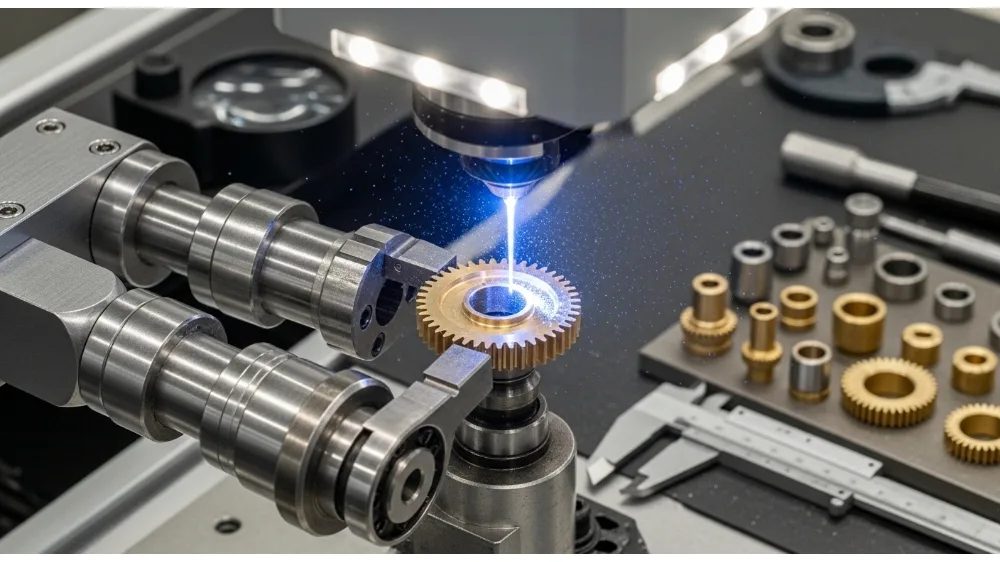
Gearing Manufacturing Procedures
Hobbing
Hobbing is a continually cutting process in which a hob (a special purpose cutting tool) turns in step with the work piece to form teeth. This process is flexible and can accommodate spur, helical and worm gears and can fulfill small and large production volumes. Hobbing is very precise and surface finish.
Shaping
Gear shaping is a process that entails the use of a reciprocating cutter which is used to remove material to create gear teeth. It particularly works best with internal gears and non-standard tooth profiles. Although hobbing is faster, shaping is not restricted in tooth geometry and is typically applied to custom or low-volume components.
Broaching
Brooding entails the utilization of a toothed instrument that is either drawn or pushed through the object of work to cut out material. Broaching may be done to internal gears and splines. Broaching offers very precise and repeatable tooth profiles, at the cost of tooling that is very costly and is generally only used where high volume is needed.
Gear Milling
Gear milling is a subtractive process whereby a rotating cutter is used to cut teeth into the piece. Milling is less expensive than hobbing, but is cost-effective in the case of prototypes and low-volume production. The CNC gear milling machines are flexible and accurate when using complex profiles.
Forging and Casting
Forging of gears is achieved through the shaping of heated metal under high pressure hence the high strength and fatigue resistance. Cast gears are fabricated by putting liquid metal into molds. Casting can be used to make large, low-speed gears of complicated geometry although secondary machining might be necessary to achieve accuracy.
Additive Manufacturing
Printing of metal gears is a new process, which is applicable to prototyping as well as small-scale manufacturing. Additive processes permit very intricate geometries and internal aspects, which are not possible by conventional procedures. Heat treating, or surface finishing, may then be required to attain the mechanical performance.
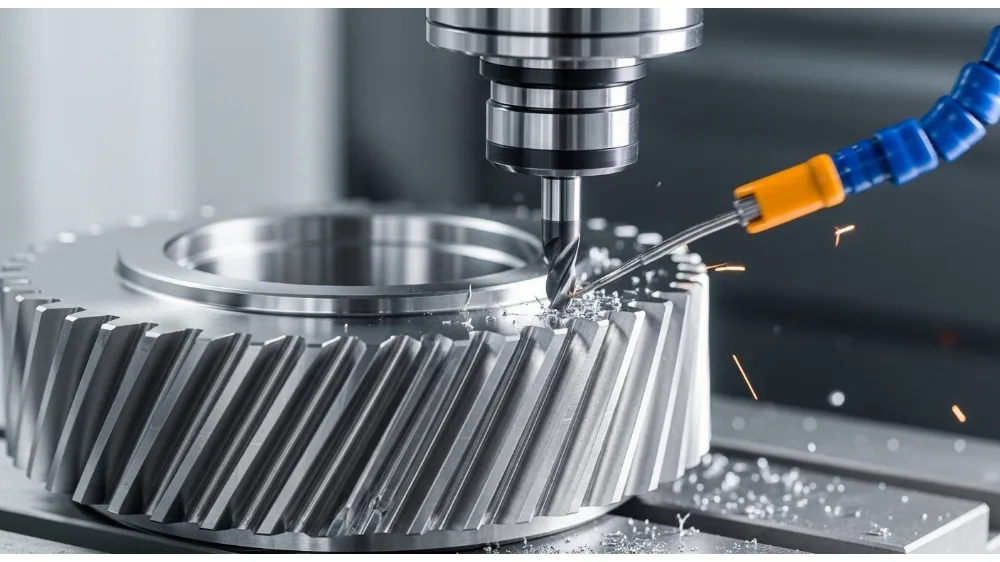
Complete and Heat Treatment
Tightening gear may involve finishing to improve performance:
Grinding: Enhances finish and attains small dimensional tolerances. The high speed or precision applications require gear grinding.
Lapping: Eliminates small surface defects and provides a smooth contact of the teeth.
Heat Treatment: The carburizing, induction hardening or nitriding techniques ensure that the surface is harder, although the core remains tough. Wear resistance and life are increased through proper heat treatment.
Gear Production and Control of Quality
To keep the gears in good condition, it is necessary to check them carefully:
Dimensional Inspection: This is done to check the tooth profiles, pitch, and alignment with the help of coordinate measuring machines (CMM) or gear analyzers.
Material Testing: Ascertainments hardness, tensile strength, and surface.
Surface Finish Inspection: Provides gears which are within functional specification and performance requirements.
Batch Sampling and Traceability: Provides consistency of quality in large scale production.
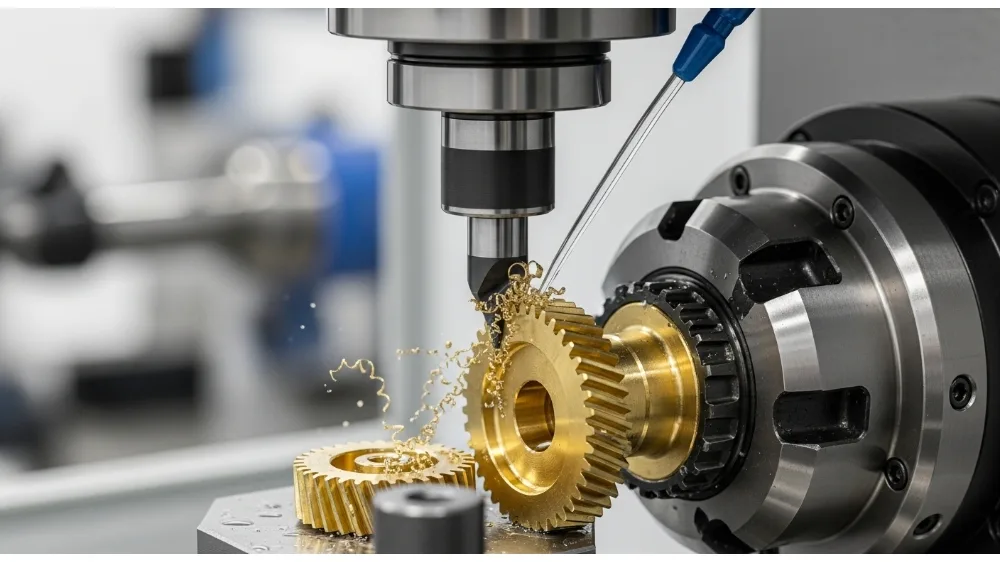
Issues that Affect Gear Production Choice
The selection of the appropriate manufacturing process requires:
Volume of Production: Hobbing or broaching is favored by high-volume production whereas milling or additive can be used in low-volume prototypes.
Material Type: Hard steels can be difficult to cut or heat treated and plastics and weaker metals can be machined more easily.
Complexity of Teeth: Helical, bevel and worm gears are gears that need accurate machining plans.
Tolerance Requirements: Rapid or precision processes have a need to grind or finish to tight tolerances.
Cost: The cost of tooling, material and process should be in tandem with production objectives.
Common Mistakes in Gear Production
- Ignoring the choice of materials to be used in application loads.
- Making the wrong decision on a production process either volume or geometry.
- Leaving finishing or heat treatment out, decreasing tool life and performance.
- Disregard of surface quality and backlash with creation of noise and inefficiency.
Benefits of Modern Gear Manufacturing
Modern gear production offers:
- Very high precision and reproducibility.
- Increased mechanical strength.
- Flexibility in complex geometries.
- Automation reduces cycle times.
- Uniform surface finish and reliable performance.

Manufactured Gears Applications
Applications of gears are found in industries:
- Automotive: Transmission, differentials, timing systems.
- Aerospace: Flight control systems, actuators.
- Industrial Machinery: Conveyors, heavy equipment.
- Consumer Electronics: Small precision gears in printers, robotics, appliances.
- Renewable Energy: Wind turbine gearboxes.
Frequently Asked Questions (FAQ)
Q1: What is precision gear manufacturing?
Precision gear manufacturing is defined as the production of gears with exact dimensions, tolerances, and surface finish to ensure reliable power transmission.
Q2: Which method of gear manufacturing is the most versatile?
Hobbing is highly versatile and can efficiently produce spur, helical, and worm gears.
Q3: How does heat treatment affect gears?
Heat treatment enhances surface hardness, wear resistance, and fatigue life without compromising the gear core’s toughness.
Q4: Are plastic gears suitable for industrial applications?
Yes, plastic gears work well in low-load, low-noise applications like consumer electronics.
Q5: What is the difference between hobbing and milling?
Hobbing continuously cuts teeth and is suited for high-volume production; milling is slower and suitable for prototypes or low-volume parts.
Q6: How is gear quality inspected?
Inspection involves checking tooth profile, surface finish, hardness, and dimensions using CMMs, gear analyzers, and material testing.
Q7: Can additive manufacturing replace conventional gear production?
Additive methods are useful for prototyping or low-volume production. High-performance or high-volume gears still rely on traditional machining and finishing.
Conclusion
Excelling in precision gear manufacturing requires understanding material properties, selecting suitable production methods, and applying proper finishing and inspection. Effective management of every stage—from material selection, cutting, heat treatment, to quality control—ensures high-performance, long-lasting gears for automotive, aerospace, industrial, and consumer applications. Modern technologies and optimized processes help manufacturers achieve consistent quality, reduce costs, and improve operational efficiency.